


Walk with me through both sides of the war front, comfort each of the injured parties and make peace with an unsettling conclusion. Let’s go!
First, we’re making sure we start on the same page, here’s a short as is map:
A few years ago, work from home (wfh) became the new normal working environment, either in full or hibrid (part office/ part home) scenarios.
We have all experienced the benefits of wfh and nowadays there is a strong shift towards more office work. This is our battleground and we will now uncover the defense lines of each side, aka hard scientific data.
Warning: whatever side you favor, it might be difficult to face some of the arguments objectively. Take the Courage pill.
The less popular work from office (wfo) side:
~ Harvard Business Review (2013): wfh => isolation, difficulty in separating work from home life, the potential loss of organizational culture.
Face-to-face interactions favor innovation, mentoring, and building a cohesive work environment.
~ MIT Sloan Management Review (2019): wfh => remote work leads to communication challenges, reduced collaboration, difficulties in building trust.
These are often better addressed in a traditional office setting.
~ Journal of Business and Psychology (2019): wfh => increased work-family conflict, particularly in families with strained relationships.
The physical separation of office and home can help maintain a healthier work-life balance and reduce stress.
~ Stanford University (2021): wfh => reduced networking opportunities and difficulties in fostering company culture.
~ Harvard Business Review (2017): wfh => Lack of physical presence and spontaneous interactions result in poorer communication, creativity, and problem-solving.
If you are a wfh enthusiast and you got through this, my sincere congratulations!
Now let’s switch sides to the popular work from home (wfh) side:
~ Stanford University Study (2015): wfh => remote workers showed a 13% performance increase. Benefits included improved work satisfaction and reduced attrition rates.
~ Harvard Business Review Analysis (2020): wfh => remote work can lead to increased productivity, better work-life balance, and significant cost savings for companies.
~ Gartner Survey (2020): wfh => a large percentage of CFO’s planned to make remote work permanent, citing benefits like cost reductions and increased employee productivity.
~ Owl Labs Report (2020): wfh => remote workers were not only more productive but also happier and more likely to stay in their jobs longer
~ Buffer’s Annual Report (2021): wfh => remote workers enjoyed greater job satisfaction and flexibility, with the majority expressing a desire to continue working remotely.
Now how do you feel about these studies? Did they make you switch sides? I don’t think so, correct me if I’m wrong, in the comments section, but my guess is that no rational argument will.
The first thing I propose for you to take from this is: wfh/wfo preference is a personal, subjective choice, no matter how much we try to rationalize it and make it sound logical.

Therefore, it is futile to throw arguments at each other, everyone chooses what’s in their personal best interest at that time. Also, sometimes the decision is fueled by unorthodox, unspoken reasons, so all that is really discussed is just the tip of the iceberg, which will never be a game changer. I’ll give a few examples of hidden layers, from both sides:
– I like spending time with my partner at home, working together and sharing the space, seeing each other more often;
– I like to do some minor chores in the short brakes (wash clothes or dishes, fold laundry), it’s relaxing and helpful;
– It’s easier to solve personal problems like appointments to the doctor, mechanic, notary;
– It’s easier to handle activities for children or accommodate them to kindergarten or school programs;
– Some days I’m tired or not feeling well and it’s way better to stay at home and skip all the preparation and commute time;
– As a manager, it’s so time consuming to stay in touch with everyone when they wfh
– At the office I know when my colleagues are available, in wfh I keep writing to them, they sometimes appear away or available but don’t answer and it’s ineficient to solve things
– As a manager, at the office I can see if someone is too tired, sick or … drunk and they can’t play video games or watch Netflix all day
– As a manager, I feel that wfh will remove team identity and chemistry and all that will matter to employees will be the paycheck
– Even when I know I can’t work well from home, I will still prefer it because kindergarten is expensive, commuting is tiering, I save cash eating at home or I like working from different locations
The second thing I propose for you to take from this is: wfh/wfo preference can be presented with logical arguments but backed by personal needs which are rarely openly discussed, so exchanging arguments will not affect them, nor change anyone’s opinion.

Now let’s get to the injured parties and try to emphatically resonate to each situation:
– I prefer wfh, but I’m new in this company and learning on the job would be so much more efficient and enjoyable at the office
– I prefer wfh, but I feel lonely at home and really miss the social interactions at work
– I prefer wfh and doing that with kids is really helpful, but I long for working in a modern business environment, without needy and loud kids around
– I prefer wfh, but networking is really absent and that makes doing my job harder
– I prefer wfh, but I tend to work longer hours and have a messy schedule
– I prefer wfo, but the flexibility of working some days at home would be so relaxing
– I prefer wfo, but sometimes it’s really hard to make it in time to school or different appointments
– I prefer wfo, but when I get home I feel to tired to cook, play, spend quality time
– I prefer wfo, but I feel I need more personal time
The third thing I propose for you to take from this is: wfh/wfo preference, no matter how strongly advocated, also has some pain points we can relate to. Exploring them can bring us together and the conversation is pleasant and meaningful.

For the final point I’m trying to make here’s how our preferences can change in time, as we evolve in the business or in our personal lives, encounter challenges or discover passions.
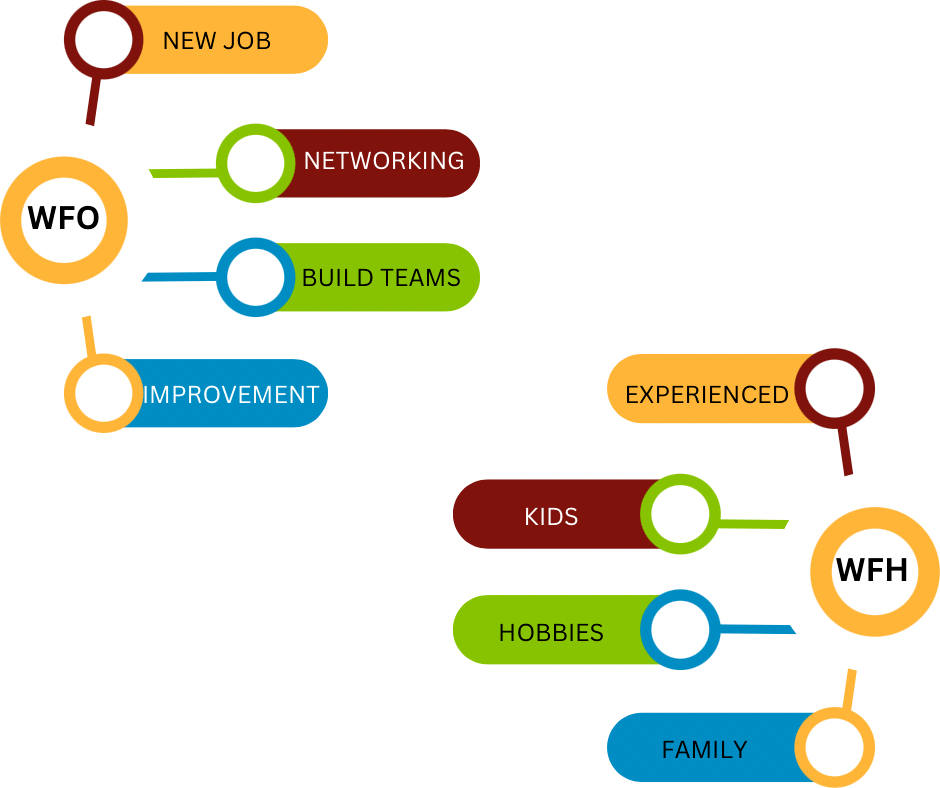
When new at your job or in the organization a wfo environment helps you learn and settle in. Or maybe you wish to push for a promotion you need, you will have increased visibility and opportunities to showcase your effort with more personal interactions at the office.
Networking is much easier at a coffee break or by a casual meet on the hallway, and as you evolve in your career and role, networking is necessary.
In a new manager role or as a new manager in a company, you will find wfo more suitable for team spirit, chemistry and good atmosphere.
When you receive objectives to improve workflows or processes/products, you will find that communicating in person is more efficient.
On the other hand:
When you become experienced in your role you will focus better at home and work with less interruptions.
When kids appear in your life you will value the time spent with them and the flexibility of wfo although work productivity will sometimes be affected.
If you enjoy a hobby or discover a new passion, wfh will more easily include it in your schedule.
Having a family, living with kids, teenagers or taking care of elderly parents, will put a focus on time spent with them and personal chores.
The forth and last thing I propose for you to take from this is: wfh/wfo preference changes in time and you may find yourself in different scenarios and with different needs, so keep an open heart.
And now for the promised unsettling conclusion: be prepared to make changes to better accommodate your needs and future needs, as time passes. Don’t put your happiness on your employer’s shoulders. On the long run we all may switch sides, so be understanding.
Work hard, stay sharp.
 Working & parenting artfully. Also, sometimes living passionately.
Leave a comment